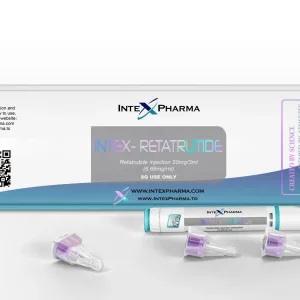
Retatrutide has attracted significant attention because of promising clinical research into its potential role in weight management and metabolic health. As interest grows, consumers may encounter websites, online sellers, social media posts, and advertisements using terms such as intex pharma retatrutide. This makes source verification especially important. Before accepting claims about any retatrutide product, consumers should understand where the substance comes from, whether the information can be independently confirmed, and what evidence supports the claims being made.
Retatrutide itself is an investigational medicine developed by Eli Lilly. It is a once-weekly triple hormone receptor agonist that targets GIP, GLP-1, and glucagon receptors. As of July 2026, Lilly states that retatrutide has not been approved by the FDA or any other regulatory agency and is legally available only through its clinical trials.
Understanding What Retatrutide Is
Retatrutide is being studied as a potential treatment for obesity, overweight with related health conditions, type 2 diabetes, and several other metabolic conditions. Clinical research has produced encouraging results, including substantial weight reduction in several Phase 3 trials. However, positive clinical results should not automatically be interpreted as evidence that every product marketed online under the name retatrutide is authentic or equivalent to the substance studied in clinical trials.
This distinction is essential when researching intex pharma retatrutide. A product name, website description, laboratory photograph, or customer testimonial does not establish the identity, purity, concentration, sterility, or safety of a substance.
Why Source Verification Is Essential
Source verification means determining who actually produced a substance, under what standards it was manufactured, how its identity was established, and whether relevant documentation can be independently evaluated.
For a research compound or investigational medicine, these questions become particularly important. Consumers may encounter claims that a product is pharmaceutical grade, highly pure, tested by an independent laboratory, or manufactured according to professional standards. Such statements should be supported by meaningful evidence rather than accepted simply because they appear on a product page.
Lilly specifically warns that products sold outside its clinical trials may contain unknown ingredients, contaminants, impurities, incorrect amounts of active ingredient, or even a completely different ingredient.
Therefore, source verification is not merely a matter of comparing prices or reading online reviews. It is fundamentally about evaluating whether there is credible evidence behind the product’s identity and quality.
Examine the Identity of the Supplier
One of the first steps in researching intex pharma retatrutide is identifying the actual supplier behind the name. Consumers should look for clear information about the company, including its legal identity, physical presence, contact information, manufacturing relationships, and stated purpose for supplying the material.
A professional-looking website does not necessarily prove that a supplier is legitimate. Similarly, a company name containing terms such as “pharma,” “laboratory,” or “research” does not automatically establish pharmaceutical manufacturing credentials.
Consumers should be cautious when supplier information is vague, contradictory, or difficult to verify independently. A trustworthy source should be willing to provide clear information about what it sells and what it does not claim about its products.
Review Laboratory Documentation Carefully
Certificates of analysis, commonly called COAs, are frequently mentioned when discussing research chemicals. However, simply having a document labeled “COA” does not prove that the product is authentic.
A meaningful laboratory report should contain identifiable information about the tested material, testing methods, results, dates, and laboratory responsible for the analysis. Consumers should also consider whether the laboratory can be independently identified and whether the document corresponds to the specific batch being discussed.
Even laboratory testing has limitations. A test showing the presence of a particular compound does not necessarily establish that an injectable product is sterile, safe for human administration, correctly manufactured, or suitable for medical use.
For that reason, laboratory paperwork should be viewed as one part of source evaluation rather than a substitute for regulatory authorization.
Separate Clinical Evidence From Marketing Claims
Another important part of source verification is distinguishing evidence about retatrutide itself from evidence about a particular supplier.
Lilly reported positive Phase 3 results in 2026. In TRIUMPH-1, participants receiving 12 mg retatrutide experienced an average 28.3% reduction in body weight over 80 weeks. Lilly also reported positive topline results from TRIUMPH-2 and TRIUMPH-3 in July 2026.
These findings provide information about retatrutide studied within controlled clinical research. They do not establish that an independently marketed product labeled intex pharma retatrutide contains the same material, has the same quality characteristics, or can produce the same outcomes.
This distinction is often overlooked in online marketing. A supplier may reference legitimate clinical research while offering a product that has not been evaluated in the same manner. Consumers should therefore ask whether a claim applies to retatrutide as studied in clinical trials or specifically to the product being offered.
Be Careful With Online Reviews
Online reviews can provide useful information about customer service, shipping, packaging, or purchasing experiences, but they have limited value for establishing pharmaceutical quality.
A positive review cannot confirm the chemical identity of a product. Likewise, a negative review may describe an individual experience without proving why a particular outcome occurred.
When researching intex pharma retatrutide, reviews should therefore be treated as supplementary information rather than primary evidence. More important questions involve traceability, documentation, manufacturing standards, regulatory status, and independent verification.
Watch for Unsupported Safety and Dosing Claims
Consumers should be especially cautious about websites that present precise dosing instructions, promises of guaranteed weight loss, or claims that a product is safe for human use without appropriate regulatory authorization.
Retatrutide remains investigational as of August 2026. Lilly says it is continuing clinical development and plans to submit a Biologics License Application to the FDA in the first quarter of 2027.
This means consumers should not treat online product descriptions as substitutes for professional medical guidance or regulatory approval. The fact that researchers are studying a compound does not mean that an unapproved version purchased elsewhere is appropriate for personal use.
Consider the Difference Between Authenticity and Safety
Authenticity and safety are related but separate questions. A substance could theoretically contain the expected active ingredient and still present concerns involving contamination, concentration, sterility, storage, handling, or manufacturing quality.
This is particularly important for injectable substances. Consumers should not assume that a product is appropriate for injection simply because it is described as pharmaceutical grade or supplied with laboratory documentation.
The safest approach is to distinguish between scientific information about retatrutide and claims made about products available outside authorized clinical research.
A Practical Verification Approach
A careful research process can begin with several basic questions. Who developed the compound? What is its current regulatory status? Who manufactured the specific product? Can the supplier’s identity be independently verified? Is batch-specific documentation available? Can the testing laboratory be identified? Does the documentation support the precise claims being made? Are marketing statements consistent with information from credible scientific and regulatory sources?
For intex pharma retatrutide, these questions can help consumers avoid relying solely on advertisements, testimonials, or search-engine results.
The strongest sources of information are generally regulatory agencies, clinical trial records, peer-reviewed scientific publications, and information from the company conducting the clinical development program. These sources can provide considerably more reliable context than anonymous product listings.
Making Research More Evidence-Based
The growing interest in retatrutide demonstrates why source verification matters. Promising clinical research can generate legitimate excitement, but that excitement can also create opportunities for misleading marketing and questionable products.
Consumers researching intex pharma retatrutide should therefore focus on verification rather than assumptions. A product name alone cannot establish authenticity. A positive review cannot establish purity. A certificate cannot automatically establish suitability for human use. And clinical trial results cannot automatically validate an unrelated commercial product.
As retatrutide continues through the regulatory process, the distinction between investigational research and consumer products remains particularly important. Careful source evaluation allows consumers to understand what is supported by evidence, what remains uncertain, and which claims require additional verification.
Ultimately, source verification is about more than finding a reputable-looking seller. It is about tracing claims back to credible evidence and recognizing the difference between an investigational medicine studied under controlled conditions and an independently marketed substance carrying the same name. That distinction is one of the most important considerations for anyone researching retatrutide online.